
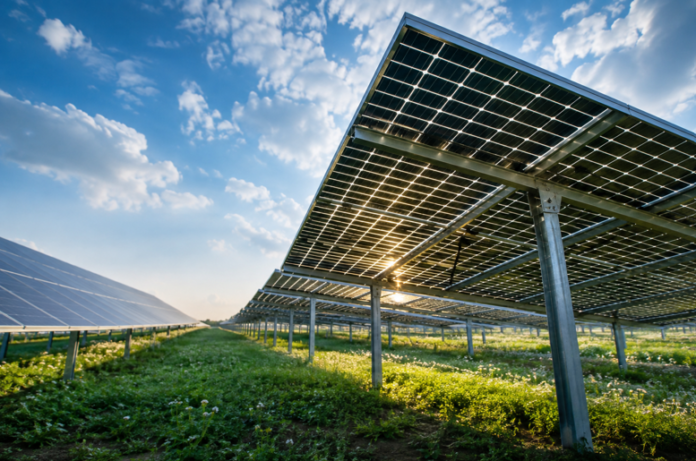
Have you ever wondered if solar panels could absorb sunlight from both sides instead of just the front surface? Monofacial modules only collect light that directly strikes their top glass, leaving reflected ambient light completely uncaptured. Bifacial panels solve this limitation by collecting light on both the front and back sides, transforming unused sunlight into clean energy. Understanding how bifacial absorption works helps homeowners, business owners and project developers select the right technology for their power needs.
What Are Bifacial Solar Panels?
Bifacial solar panels are photovoltaic (PV) modules that generate electricity from both the front and rear sides. Unlike monofacial solar panels, which have an opaque backsheet, bifacial panels use a transparent glass layer on the back. This design allows the front side to capture direct sunlight while the rear side absorbs sunlight reflected from the ground, rooftops or other nearby surfaces. As a result, bifacial panels can utilise additional light that would otherwise go unused.
Some key features of bifacial solar panels include:
- Dual-glass design: Glass on both sides protects the solar cells from moisture, heat, dust, and physical damage, helping improve long-term reliability.
- Rear-side power generation: The rear side can produce around 70% to 80% of the power generated by the front side, depending on the solar cell technology and installation conditions.
- Long service life: The dual-glass construction helps reduce the risk of issues such as Potential Induced Degradation (PID) and micro-cracks, contributing to consistent performance over the panel’s lifespan.
- Better use of reflected light: The ability to capture reflected sunlight can increase overall energy generation in suitable installation environments.
How Do Bifacial Panels Collect Sunlight From Both Sides?
Bifacial solar units collect direct sunlight on the front face while using surface reflection, known as albedo, to capture light on the back face. When sunlight hits the ground or roof surface beneath an array, a portion of that light bounces back upward. The rear silicon cells absorb this reflected radiation, generating extra electrical current without requiring additional installation area.
Key factors that determine total energy generation on the rear side include:
- Ground Reflectivity (Albedo): Light-colored surfaces like white roofs, concrete, sand or snow bounce more light back into the rear side of the panel.
- Mounting Height: Raising the panel higher off the surface creates more space for reflected light to reach the underside.
- Tilt Angle: Pitching panels at optimal angles boosts rear exposure to ambient sunlight throughout the day.
How Much Extra Energy Do Bifacial Solar Panels Produce?
Bifacial modules generate up to 30% more total energy output compared to standard single-sided panels under ideal ground reflectivity conditions. Global Market Insights estimates the global bifacial solar module market size at USD 217.9 billion in 2026, driven by growing demand for high-efficiency dual-sided technology. Leading solar panel manufacturers like Avaada Electro produce high-efficiency N-Type TOPCon bifacial modules with dual-glass designs, delivering up to 30% additional power generation gains based on surface reflectivity.
| Surface Type | Surface Reflectivity (Albedo) | Expected Rear Power Gain | Total Generation Advantage |
| Dark Gravel / Soil | 10% – 15% | 5% – 8% | Moderate Boost |
| Green Grass | 15% – 25% | 8% – 12% | Standard Boost |
| Concrete / Light Sand | 30% – 40% | 12% – 18% | High Boost |
| White Membrane / Snow | 60% – 80% | 20% – 30% | Maximum Boost |
Where Is a Bifacial Solar Installation Most Effective?
A bifacial solar installation performs well in locations where both sides of the panel can receive sunlight. These systems are most effective in open spaces with light-coloured surfaces that reflect sunlight onto the rear side of the panels. They also require minimal shading beneath the installation to improve energy generation. While conventional solar panels are commonly installed on dark rooftops, bifacial panels are better suited to elevated structures and reflective surroundings.
Common applications include:
- Utility-scale solar farms: Ground-mounted systems installed over light-coloured soil, sand or gravel can make better use of reflected sunlight across large sites.
- Commercial flat rooftops: White or reflective roof surfaces help direct sunlight to the rear side of elevated panels, supporting improved energy generation and reducing the levelized cost of energy (LCOE).
- Agrivoltaic projects: Raised solar panels allow sunlight to reach both sides while providing partial shade for crops below.
- Solar carports: Elevated installations above parking areas enable the rear side of the panels to capture reflected light while also offering shade for parked vehicles.
Choosing the right installation site helps improve the overall performance of a bifacial solar system.
Final Thoughts
Bifacial solar panels represent a significant step forward in solar energy efficiency. By absorbing sunlight from both sides and leveraging ground reflection, these dual-sided modules deliver up to 30% higher energy yields than standard single-sided panels. Choosing advanced N-Type TOPCon dual-glass technology ensures higher power output, stronger durability and long-term clean energy performance for various power applications.

