
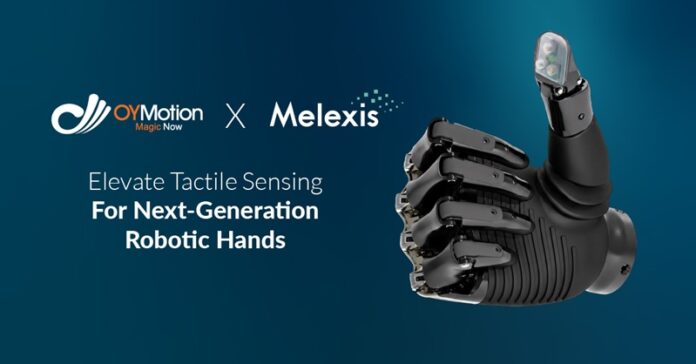
Melexis is accelerating its robotics roadmap as Tactaxis®, a breakthrough magnetic tactile sensor, evolves into industrialized fingertip modules. Building on early momentum, Melexis has joined forces with bionic pioneer OYMotion to integrate Tactaxis® into next-gen robotic hands, delivering the human-like dexterity and neural-grade feedback needed to bridge the gap between physical-AI hardware and intelligent touch.
Melexis Robotics Update
Leveraging its extensive sensor and driver expertise, Melexis has been quick to enter the robotics market, delivering both solutions from its existing portfolio as well as dedicated innovations for the robotics market. By embedding sensing directly into application-ready modules, Melexis will enable faster integration and reduce development complexity for robotics manufacturers, supporting quicker adoption of advanced sensing capabilities.
Having moved from prototyping into the industrialization phase, these modules are now being prepared for broader deployment into scalable, production-ready solutions. For robotics OEMs, Tactaxis® modules represent a clear step forward in enabling true tactile sensing in robotics, bringing more precise, responsive interaction closer to real-world applications.
Tactaxis® is an advanced magnetic-based tactile sensing technology that enables true 3D detection of force, position, and interaction. It converts physical touch into precise, real-time data, supporting more controlled, responsive, and adaptable interactions. While robotics systems have made significant advances in vision and actuation, the ability to reliably detect and interpret physical interaction remains a key limitation, one that Tactaxis® fingertip modules resolve.
Supporting Next-Generation Robotic Hands with OYMotion
Melexis’ Tactaxis® sensors have been selected by OYMotion for the development of its next-generation robotic hand, due to be demonstrated at Hannover Messe in Germany. OYMotion, a leading Chinese developer of advanced robotic technologies, was seeking a solution capable of enabling more advanced interaction while requiring rapid development and close collaboration to meet key deadlines.
Bringing together teams and key stakeholders across both companies, the project covered the full integration scope, from mechanical and electronic design through to calibration and system-level optimization within a condensed timeframe. The resulting system provides a tangible demonstration of Tactaxis® technology ahead of future mass production and shows how sophisticated tactile sensing can elevate robotic manipulation capabilities in real-world conditions.
“Our work with OYMotion is an important step in demonstrating how our tactile sensing can elevate real robotic systems,” said Vincent Hiligsmann, Chief Innovations Officer at Melexis. “Today, the robotics industry is advancing faster than defined requirements, and the sense of touch remains a key limitation. With Tactaxis®, we are addressing that gap through true 3D sensing and industrialized fingertip modules that can be deployed at scale. It is this combination of capability and manufacturability that will be key in enabling broader adoption of tactile sensing across next-generation robotic platforms.”
“At OYMotion, we believe that the next generation of robotic hands should combine dexterous actuation with rich tactile perception. Building a truly capable robotic hand is not only about motion control, but also about understanding contact in real time. Our collaboration with Melexis brings advanced tactile sensing into a practical robotic hand platform, enabling more precise, adaptive, and human-like interaction with the physical world,” said Hualiang Ni, Founder and CEO of OYMotion
Advancing Toward Industrialized Deployment
As momentum builds across the robotics ecosystem, translating emerging sensing capabilities into deployable systems is becoming a defining challenge for the industry. Melexis is addressing this by advancing the industrialization of its Tactaxis®-based fingertip modules, moving beyond early validation toward solutions designed for integration into production platforms. By aligning sensing performance with the requirements of scalability and system-level integration, the company is laying the foundation for broader adoption of tactile sensing in robotics.
For more information, visit melexis.com/robotics

