
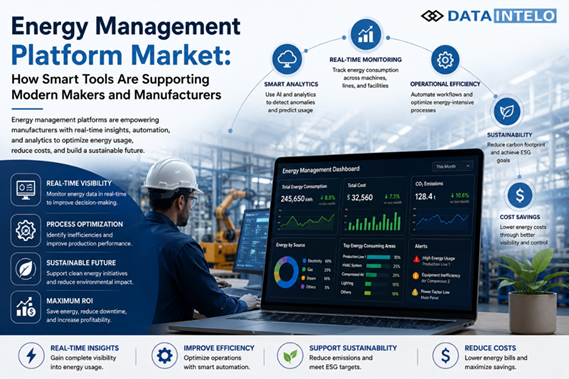
Currently, manufacturing businesses are being compelled to operate in an efficient manner while striking a balance between flexibility and sustainability. Factors like rising energy rates, stricter environmental rules, and advanced use of technology have changed production. In light of these changes, energy management platforms have emerged as key elements of the industrial technology layer by combining real-time data, automated processes, and analytics to assist manufacturing companies and smaller makers with energy use.
According to DataIntelo, the global market for energy data management platform reached $8.6 billion in 2025 and is predicted to increase to $19.7 billion by 2034 with a compound annual growth rate of 9.8% during the forecasting period from 2026 to 2034.
From Metering to Intelligent Energy Orchestration
The first energy management solutions concentrated on measuring and reporting, with information about consumption coming in periodic facility-level reports. The trend over the last ten years has been towards intelligent energy solutions that can communicate with production machinery, control systems, and corporate information systems to manage energy usage more dynamically.
Today’s energy management platforms typically offer:
- Unified dashboards that enable tracking of energy, gas, water, and compressed air use across different locations.
- Interfacing with IoT systems, smart gauges, and SCADA frameworks to ensure that detailed time series data becomes available.
- Data analysis engines capable of finding out inefficiencies, abnormalities, and minimizing energy consumption.
- Either AI-based or rule-driven automations will make it possible to control HVAC, lighting, motors, and production equipment based on energy signals.
Within the context of manufacturing, moving from simple monitoring to smart orchestration makes it possible to coordinate energy consumption with the operational timetable, maintenance periods, and constantly changing tariffs instead of incurring it automatically.
Market Drivers Shaping Energy Management Platforms
Energy Management Platforms Market is currently being shaped by the convergence of technological, political, and economic factors.
- Regulatory requirements and sustainable development initiatives serve as the main driving factors behind this growth. Governments and the industry authorities are starting to enforce stricter rules for energy efficiency and greenhouse gas emission reporting systems, especially in energy-intensive industries, such as metals, chemicals, automotive, and electronics. Many industrial players have also committed to the internal decarbonization strategy, creating demand for measuring, verifying, and optimizing energy performance.
- Unstable energy prices and constraints of the grid: The unpredictability of energy prices and constraints of the local grid make forecasting of consumption and managing of loads more relevant in terms of cost control and continuity of operations. Hence, having platforms that can simulate scenarios and incorporate demand response strategies is important in this context.
- Digitalization of factories and makerspaces: The advent of the Industrial IoT, digital twinning and wired production lines has led to an increase in the data available on the condition of assets and the environment, so now it can be utilized in energy management platforms for transitioning from static efficiency measures to operational efficiency optimization.
- Integration of renewable and decentralized energy resources: Rooftop solar, in-situ storage and combined heat & power (CHP) systems are being increasingly implemented in manufacturing plants and innovation centers. In this regard, platforms able to monitor generation, manage the energy storage and supervise energy consumption according to generation are very useful for achieving the sustainability and resilience goals.
In combination, these factors are driving the trend of adopting energy management systems through medium sized manufacturers, large industrial enterprises and technology-driven manufacturing sectors.
How Smart Tools Support Modern Makers and Manufacturers
Energy management systems provide the best demonstration of their usefulness for the efficiency of manufacturing, because of their effects on productivity, cost and
sustainability at the same time. Among the features of energy management systems that are improving the work process, one can mention:
- Visible energy usage at the process level. Energy management systems have access to machine-level sensors, which provides them with data about energy consumption in relation to any specific production line, batch or project.
- The use of historical data together with benchmarking tools enables organizations to compare performance with reference to various facilities, shifts carried out, and product lines. This allows for the implementation of continuous improvement concepts such as lean manufacturing and Six Sigma from the angle of energy saving practices; the effectiveness of these concepts is made measurable through the collected and processed data.
- Through the analysis of energy signatures it is possible to detect problems related to imperfect drive alignment, broken components, or inefficient operating conditions. The software helps to identify the failure and make recommendations on maintenance.
- Energy management technologies help manage shared maker spaces properly by ensuring equal use of the facilities and controlling the peak loads and thus eliminating unnecessary expenses on utilities.
For instance, a medium-sized manufacturer of electronics can implement an energy management system to supervise the energy consumption throughout surfaces mount and or assembly lines, solder reflow heaters, testing workbenches, and air conditioning systems. The tracking of energy consumption and output allows for modification of machinery and processes.
Technology Building Blocks: IoT, Cloud, and Analytics
Today’s energy management systems are built on various technologies that are gaining popularity in industry and manufacturing. The essential elements of these systems are as follows:
- Internet of Things and edge computing devices. Devices such as smart meters, sub meters, environmental sensors, and edge computing gateways ensure fine-grained data about consumption and operation conditions. When seriously used, these technologies help systems gather energy consumption profiles based on assets or zones instead of relying solely on the utility feeds.
- Data platforms on the cloud. There is a huge number of Energy Management Platforms (EMPs) utilizing cloud technologies for storing historical data, providing multi-site deployment options, and presenting web-based dashboards operating in plants and remote offices. Such an infrastructure increases its capabilities in correspondence to the data volumes and allows active collaboration of engineering, operating, and sustainability departments.
- Using analytics and machine learning. Advanced solutions apply pattern-matching, forecasting, and optimization algorithms to find ways to improve operations and predict situations like tariff modifications or equipment upgrades. Although not every solution is using AI at its full scale, analytical capabilities gain importance in differentiation of products.
- Integration with enterprise and industrial systems. The use of APIs and connectors allows exchanging data between Energy Management Platforms (EMPs) and Enterprise Resource Planning (ERP), Manufacturing Execution Systems (MES), building management systems, as well as maintenance tools. This enables creating
working scenarios in which energy data can initiate operational actions (for instance, rescheduling production and launching maintenance).
Such building blocks are becoming familiar to manufacturers opting for Industry 4.0 projects resulting into a better case for adding energy management platforms into the overall digital transformation strategy.
Adoption Patterns and Use Cases Across the Market
The energy management platform sector caters to various manufacturing and maker environments, each with different needs and limitations.
Examples of these markets include:
- Big industrial companies. Multi-plant manufacturing firms often employ energy management platforms across their factories and distribution centers in order to unify energy policies, utilize economies of scale, and conduct enterprise-level reporting on sustainability KPIs. Platforms within this sector provide special emphasis on scalability, integration and advanced analytics.
- Mid-sized companies dealing with manufacturing and production. Companies operating from one or a couple of manufacturing units focus on improving process effectiveness, minimizing demand charges, and being able to assess the efficiency of investment into hardware upgrades and/or generation. They tend to prefer solutions that have quantifiable ROI parameters as well as feasible implementation timelines.
- Creative laboratories and maker centres.A location householding digital fabrication technologies, test equipment, and prototypes is increasingly using energy solutions to manage expenses and decrease environmental impact. User-friendly dashboards make it easier for administrators to deliver the information regarding the energy use to the target groups.
- Industry-specific solutions. Particular industries like food production and distribution, cold chain logistics, and precise manufacturing are utilizing EMPs for managing their temperature-sensitive or process-dedicated energy consuming devices. The functionality of the platform is based on industry regulations and operational requirements.
The highest level of the acceptance of energy management platforms is observed when energy costs are significant for profitability, regulation is strict, and digital capacity is already available or is under construction.
Obstacles and points for consideration in implementation
Although energy management solutions are highly beneficial, the process of their implementation is challenging. The representatives of manufacturing and producing sectors should consider some practical points in order to benefit fully from these tools.
The major problems to struggle with are as follows:
- The quality and coverage of the information. The efficiency of EMP depends upon accurate metering, modern instruments, and reliable sources of information. A structured instrument plan that covers all devices and territories needs to be implemented prior to the successful use of the system
- Change management and user adoption. Energy optimization is often dependent on making modifications in terms of habits, setpoints, and working processes. As a result, getting approval from operators, engineers, and management is critical for the implementation of configuration advice.
- Integration complexity. Connecting EMPs to existing industrial process and IT systems might necessitate custom integration efforts, security reviews, and phase implementations. Having integration roadmaps will reduce interruptions and safeguard essential processes.
- Cybersecurity and data governance. Because platforms are linked to OT and IT systems, organizations must ensure secure data flows, correct access policies, and compliance with internal security policies. This is even more important if organizations use remote access or cloud services.
Tackling these hurdles in advance could enhance energy management programs’ performance as well as quicken time to benefit.
Future Trends: Energy Platforms as an Integrated Component of Digital Manufacturing.
In the future, energy management systems are expected to become a staple of digital manufacturing and maker ecosystems instead of merely being optional features. As firms start to adopt connected machines, automate processes and implement data analytics, energy management in real-time intertwined with manufacturing and supply chain processes will become a crucial competitive factor.
The following new advances emerging in the world of technology are set to affect the future of the market in the following ways:
- The use of tools involving digital twin integration to simulate energy impacts of any new designs and transformation processes at their conceptual stage.
- The application of predictive tools to achieve a balanced approach to maintenance, production, and energy use and reduce downtime and expenses.
- The cooperation of suppliers, providers of electronic equipment, and manufacturers to create demand response initiatives and flexible pricing schemes based on the capabilities of the platform.
Modern manufacturers and producers do not see their investments in energy management systems as solely a case of adopting a standalone solution. Rather, they are aware of the necessity to implement energy intelligence into everyday decision-making across the organization. As digitally-enabled industries grow, these systems offer solutions for improving efficiency, reducing environmental impact, and achieving savings.

